Modern Approach To Regression With R Sheather Pdf Download
In statistics, the variance aggrandizement factor (VIF) is the ratio (quotient) of the variance of estimating some parameter in a model that includes multiple other terms (parameters) past the variance of a model constructed using but i term.[1] It quantifies the severity of multicollinearity in an ordinary least squares regression analysis. It provides an index that measures how much the variance (the foursquare of the gauge's standard deviation) of an estimated regression coefficient is increased because of collinearity. Cuthbert Daniel claims to have invented the concept behind the variance inflation factor, but did not come up upward with the name.[2]
Definition [edit]
Consider the following linear model with one thousand independent variables:
- Y = β 0 + β 1 X i + β 2 Ten 2 + ... + β grand Ten k + ε.
The standard error of the estimate of β j is the foursquare root of the j + 1 diagonal element of s 2(Ten′X)−one, where southward is the root mean squared error (RMSE) (note that RMSEtwo is a consistent estimator of the true variance of the fault term, ); X is the regression blueprint matrix — a matrix such that 10 i, j+1 is the value of the j th independent variable for the i thursday case or observation, and such that X i,i, the predictor vector associated with the intercept term, equals one for all i. It turns out that the foursquare of this standard error, the estimated variance of the approximate of β j , tin be equivalently expressed as:[3] [4]


where R j 2 is the multiple R two for the regression of X j on the other covariates (a regression that does not involve the response variable Y). This identity separates the influences of several distinct factors on the variance of the coefficient gauge:
- s ii: greater scatter in the information around the regression surface leads to proportionately more variance in the coefficient estimates
- northward: greater sample size results in proportionately less variance in the coefficient estimates
- : greater variability in a particular covariate leads to proportionately less variance in the corresponding coefficient estimate

The remaining term, i / (one −R j 2) is the VIF. It reflects all other factors that influence the dubiousness in the coefficient estimates. The VIF equals 1 when the vector X j is orthogonal to each column of the pattern matrix for the regression of X j on the other covariates. By contrast, the VIF is greater than 1 when the vector X j is not orthogonal to all columns of the pattern matrix for the regression of X j on the other covariates. Finally, note that the VIF is invariant to the scaling of the variables (that is, nosotros could scale each variable X j by a constant c j without changing the VIF).
![{\displaystyle {\widehat {\operatorname {var} }}({\hat {\beta }}_{j})=s^{2}[(X^{T}X)^{-1}]_{jj}}](https://wikimedia.org/api/rest_v1/media/math/render/svg/0cee84e3e333ac7600f275613c9afdb1a7b14c34)
Now let , and without losing generality, nosotros reorder the columns of X to set up the outset column to be


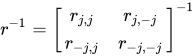
- .

By using Schur complement, the chemical element in the beginning row and showtime cavalcade in is,

![{\displaystyle r_{1,1}^{-1}=[r_{j,j}-r_{j,-j}r_{-j,-j}^{-1}r_{-j,j}]^{-1}}](https://wikimedia.org/api/rest_v1/media/math/render/svg/909c78b1378b8cacb559c9805ecafd1ab26287d9)
And so we have,
![{\displaystyle {\begin{aligned}&{\widehat {\operatorname {var} }}({\hat {\beta }}_{j})=s^{2}[(X^{T}X)^{-1}]_{jj}=s^{2}r_{1,1}^{-1}\\={}&s^{2}[X_{j}^{T}X_{j}-X_{j}^{T}X_{-j}(X_{-j}^{T}X_{-j})^{-1}X_{-j}^{T}X_{j}]^{-1}\\={}&s^{2}[X_{j}^{T}X_{j}-X_{j}^{T}X_{-j}(X_{-j}^{T}X_{-j})^{-1}(X_{-j}^{T}X_{-j})(X_{-j}^{T}X_{-j})^{-1}X_{-j}^{T}X_{j}]^{-1}\\={}&s^{2}[X_{j}^{T}X_{j}-{\hat {\beta }}_{*j}^{T}(X_{-j}^{T}X_{-j}){\hat {\beta }}_{*j}]^{-1}\\={}&s^{2}{\frac {1}{\mathrm {RSS} _{j}}}\\={}&{\frac {s^{2}}{(n-1){\widehat {\operatorname {var} }}(X_{j})}}\cdot {\frac {1}{1-R_{j}^{2}}}\end{aligned}}}](https://wikimedia.org/api/rest_v1/media/math/render/svg/a16c16a6f490aa0b17ba9935610e47c484a31fa5)
Here is the coefficient of regression of dependent variable over covariate . is the corresponding residual sum of squares.


Adding and analysis [edit]
We can calculate k different VIFs (one for each X i ) in 3 steps:
Step one [edit]
Showtime we run an ordinary least square regression that has X i equally a function of all the other explanatory variables in the outset equation.
If i = i, for example, equation would be

where is a constant and e is the mistake term.

Stride two [edit]
So, calculate the VIF factor for with the following formula :

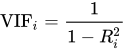
where R 2 i is the coefficient of determination of the regression equation in step ane, with on the left hand side, and all other predictor variables (all the other X variables) on the correct mitt side.

Step iii [edit]
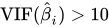
Analyze the magnitude of multicollinearity by considering the size of the . A dominion of thumb is that if then multicollinearity is loftier[v] (a cutoff of v is likewise normally used[6]).

Some software instead calculates the tolerance which is but the reciprocal of the VIF. The selection of which to utilise is a thing of personal preference.
Estimation [edit]
The square root of the variance inflation gene indicates how much larger the standard error increases compared to if that variable had 0 correlation to other predictor variables in the model.
Example
If the variance inflation gene of a predictor variable were 5.27 (√5.27 = 2.iii), this ways that the standard error for the coefficient of that predictor variable is 2.3 times larger than if that predictor variable had 0 correlation with the other predictor variables.
Implementation [edit]
-
vifoffice in the auto R package -
ols_vif_tolfunction in the olsrr R bundle -
PROC REGin SAS System -
variance_inflation_factorfunction in statsmodels Python package -
estat vifin Stata - r.vif addon for GRASS GIS
References [edit]
- ^ James, Gareth; Witten, Daniela; Hastie, Trevor; Tibshirani, Robert (2017). An Introduction to Statistical Learning (eighth ed.). Springer Science+Business Media New York. ISBN978-1-4614-7138-7.
- ^ Snee, Ron (1981). Origins of the Variance Inflation Factor as Recalled by Cuthbert Daniel (Technical report). Snee Associates.
- ^ Rawlings, John O.; Pantula, Sastry Yard.; Dickey, David A. (1998). Applied regression analysis : a enquiry tool (Second ed.). New York: Springer. pp. 372, 373. ISBN0387227539. OCLC 54851769.
- ^ Faraway, Julian J. (2002). Practical Regression and Anova using R (PDF). pp. 117, 118.
- ^ Kutner, M. H.; Nachtsheim, C. J.; Neter, J. (2004). Applied Linear Regression Models (4th ed.). McGraw-Loma Irwin.
- ^ Sheather, Simon (2009). A modernistic approach to regression with R. New York, NY: Springer. ISBN978-0-387-09607-0.
Farther reading [edit]
- Allison, P. D. (1999). Multiple Regression: A Primer. Thou Oaks, CA: Pino Forge Press. p. 142.
- Hair, J. F.; Anderson, R.; Tatham, R. L.; Black, Westward. C. (2006). Multivariate Data Analysis. Upper Saddle River, NJ: Prentice Hall.
- Kutner, One thousand. H.; Nachtsheim, C. J.; Neter, J. (2004). Practical Linear Regression Models (fourth ed.). McGraw-Colina Irwin.
- Longnecker, M. T.; Ott, R. L. (2004). A First Course in Statistical Methods. Thomson Brooks/Cole. p. 615.
- Marquardt, D. Westward. (1970). "Generalized Inverses, Ridge Regression, Biased Linear Estimation, and Nonlinear Estimation". Technometrics. 12 (three): 591–612 [pp. 605–7]. doi:10.1080/00401706.1970.10488699.
- Studenmund, A. H. (2006). Using Econometrics: A Practical Guide (5th ed.). Pearson International. pp. 258–259.
- Zuur, A.F.; Ieno, E.N.; Elphick, C.Due south (2010). "A protocol for data exploration to avert common statistical problems". Methods in Ecology and Evolution. 1: three–14. doi:10.1111/j.2041-210X.2009.00001.ten.
See also [edit]
- Pattern effect
DOWNLOAD HERE
Posted by: jacobstrus1962.blogspot.com
Post a Comment