Altered States Of Consciousness Psychology Tart Pdf Download
An contradistinct state of consciousness (ASC),[i] also called contradistinct state of heed or mind alteration, is any condition which is significantly dissimilar from a normal waking state. Past 1892, the expression was in use in relation to hypnosis,[2] though there is an ongoing debate as to whether hypnosis is to be identified as an ASC co-ordinate to its mod definition. The side by side retrievable example, past Dr Max Mailhouse from his 1904 presentation to conference,[iii] however, is unequivocally identified as such, as it was in relation to epilepsy, and is still used today. In academia, the expression was used equally early on as 1966 by Arnold M. Ludwig[4] and brought into common usage from 1969 by Charles Tart.[5] [vi] It describes induced changes in i's mental state, almost e'er temporary. A synonymous phrase is "contradistinct land of sensation".
Definitions [edit]
There is no general definition of an altered country of consciousness, equally any definitional endeavor would firstly have to rely on a definition of a normal land of consciousness.[7] Attempts to ascertain the term can still be found in Philosophy, Psychology and Neuroscience. There is no final consensus what the about authentic definition for what purpose is.[8] In the following, the all-time established and latest definitions are provided:
Arnold M. Ludwig attempted a get-go definition in 1966.
"An contradistinct country is any mental state(s), induced by various physiological, psychological, or pharmacological maneuvers or agents, which can be recognized subjectively by the individual himself (or by an objective observer of the individual) as representing a sufficient departure in subjective experience of psychological functioning from certain general norms for that private during alert, waking consciousness."[ix]
Starting from this Charles Tart focuses his definition on the subjective experience of a state of consciousness and its divergence from a normal waking state.
"Altered states of consciousness are alternate patterns or configurations of experience, which differ qualitatively from a baseline state."[note 1] [10]
Farthing's definition of an altered state of consciousness (ASC) is based on Charles Tart's terminology. Charles Tart described an altered country of consciousness as a profound change in the "overall pattern of subjective experiences".[xi] In order to define an ASC, Tart focuses on the importance of subjective experience.
Farthing adds to his definition that an ASC is short-termed or at least reversible and that information technology might not even exist recognized as an ASC at that moment. His definition relies only on subjective experience, leaving aside behavioral changes and physiological response.
"An altered state of consciousness (ASC) may exist defined every bit a temporary change in the overall design of subjective experience, such that the individual believes that his or her mental functioning is distinctly unlike from sure general norms for his or her normal waking state of consciousness". Farthing (1992, p. 205)
He lists fourteen dimensions of changed subjective experience. To account for an ASC, multiple dimensions demand to be altered.[12]
A recent working definition for empirical research is based on these previous definitions and provided by Schmidt.[7]
[Translated from German]: As a working definition for neuroscientific research, it might suffice to presume that most people take a strong intuition concerning which variability in their everyday wakeful state feels normal to them. This variability of experience is considered equally normal fluctuation, while whatever state that is experienced to diverge significantly from information technology tin exist chosen an ASC. From an experimental perspective, information technology is also reasonable to compare ASC weather condition to a baseline state – a state subjectively judged as average, or normal. The comparison with a 'normal' baseline requires that the ASC nether investigation is of relatively short duration (minutes to hours), which differentiates ASCs from near pathological conditions. Importantly, it has been emphasized that an ASC is not a mere quantitative change in a single cognitive part (e.g. elevated arousal). Instead, information technology is a multidimensional phenomenon. Thereby, the relative intensity of multiple consciousness aspects constitutes a 'phenomenological pattern' characterizing a particular state. Such 'patterns' have also been referred to as relative changes in the '(basic) dimensions of consciousness'. For empirical research, such patterns stand for to a multivariate combination of independent 'consciousness factors', which can be quantified via questionnaires. The 'phenomenological pattern' results from the factor construction of the applied psychometric assessment, i.east. the individual ratings, or gene scores, of a questionnaire.
History [edit]
History of utilization of ASCs [edit]
Altered states of consciousness might have been employed by humans as early on as 30,000 years ago.[10] Mind-altering plants and/or excessive dancing were used to attain an ecstatic or mystic state.[13] Examples of early religious use of altered states of consciousness are the rites of Dionysos and the Eleusinian Mysteries,[14] too as yoga and meditation.[10] Followers of diverse shamanic traditions "enter altered states of consciousness in social club to serve their community."[xiv] Terence McKenna has suggested that the utilise of psychedelic mushrooms in prehistoric times has led to the "evolution of man linguistic communication and symbol utilize".[fifteen] Some theorists propose that mind-altering substances, such every bit Soma, might have pushed the formation of some of the world's principal religions.[14] [16]
Meditation in its various forms is existence rediscovered by modernistic psychology because of its therapeutic potential and its ability to "enable the activity of the heed to settle down".[17] In Psychotherapy techniques like hypnosis, meditation, support psychological processes.[18]
History of the science and theoretical-modelling [edit]
Due to the behaviourist epitome in psychology contradistinct states of consciousness were dismissed as a field of scientific inquiry during the early on 20th century.[xix] They were pathologized and merely seen equally symptoms of intoxication or demonic possession.[20]
Their return into psychology began with Wiliam James' interest into a multifariousness of altered states, such every bit "mystical experiences and drug-induced states".[8] James' investigations into first-person-subjective-experience contributed to the reconsideration of introspection as a valuable research method in the academic community.[eight]
The social change of the turbulent 1960s has decisively led to a change of the scientific perspective to the signal that introspection every bit a scientific method and ASCs as valid realms of experience became more widely accustomed.[21] Foundations for the enquiry have been laid out by various scientists such as Abraham Maslow, Walter N. Pahnke, Stanislav Grof and Charles Tart.[22] They focused on seemingly beneficial aspects of ASCs such as their potential to "promote creativity or treat habit".[nine] Rather oppressive states such equally dissociation from trauma were neglected.
The findings of the famous Good Friday Experiment past Pahnke suggest that mystical experiences tin be triggered past psilocybin. Later investigations by Rick Doblin constitute that participants valued those experiences equally "spiritual high points of their lives".[10]
In the midst of the rise of new-age subculture Stanislav Grof and others formed the new field of transpersonal psychology, which emphasized "the importance of individual human experience, validity of mystical and spiritual experience, interconnectedness of cocky with others and the world and potential of self-transformation".[23]
Abraham Maslow'due south research on peak experiences, equally moments of "highest happiness and fulfillment",[23] further contributed to the depathologization of altered states.
A start summary of the existing literature was carried out by Charles T. Tart in his volume Altered us of Consciousness, which led to a more common employ of the term.[23] Tart coined the cardinal terms discrete[note 2] and baseline states of consciousness and idea well-nigh a general nomenclature organization for ASCs.[24] He also chosen for "land specific sciences"[10] in which researchers should do science on ASCs from within such states.
Nomenclature [edit]
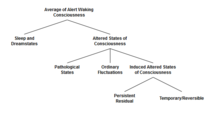
A unproblematic classification scheme for ASC. Sleep and dream states are distinguished from waking consciousness since they account for substantially different ways of the ability of memory formation and retrieval. Psychiatric diseases that continue with persistent changes of consciousness, similar schizophrenia, are covered with the term "pathological conditions". In contrast, the classification scheme includes intended and induced ASCs also equally general fluctuations of neurotransmission, which are reversible and short-termed. I step further the graph suggests splitting induced ASCs in persistent and reversible states. Translated from German Schmidt & Majic.[7]
A classification of Altered States of Consciousness is helpful if one wants to compare or differentiate between induced ASCs and other variations of consciousness. Various researchers accept attempted the classification into a broader framework. The attempts of classification discussed in the following focus on slightly dissimilar aspects of ASCs. Several authors suggested classification schemata with regard to the genesis of altered states and with regard to the blazon of experiences:
A classification with five categories was suggested past Vaitl[25] to distinguish ASCs according to how they were induced:
- Pathological (Epilepsy, brain damage)
- Pharmacological (psychoactive substances)
- Physical and physiological (fasting and sex)
- Psychological (music, meditation, hypnosis)
- Spontaneous (solar day-dreaming and about death feel)
Vaitl[26] further suggests iv bones aspects of experiences: (1) activation (2) awareness span (3) self-awareness (4) sensory dynamics. Alternatively Roland Fischer[26] suggests a classification forth ergotropic (i.e., ecstasy) or trophotropic (i.eastward., meditation) properties. The piece of work of Adolph Dittrich[26] aimed to empirically make up one's mind common underlying dimensions of consciousness alterations induced by unlike methods, such as drugs or not-pharmacological methods. He suggested three basic dimensions, which were termed: (i) oceanic boundlessness (2) dread of ego dissolution (3) visionary restructuralization. Further, Ken Wilber[ten] proposes a multidimensional system and adds that the individual experience of an ASC is shaped by a person'due south unique psychological development.
Michael Winkelman identifies four different "modes of consciousness": (1) the waking mode (2) the deep slumber mode (iii) the REM slumber / dreaming mode (iv) the integrative mode.[27] Within this framework, many ASCs (psychedelics, hypnosis, meditation, etc.) are defined equally belonging to the integrative manner.
Induction methods [edit]
Pharmacological [edit]
An altered state of consciousness may exist defined every bit a curt-term change in the full general configuration of ane'south individual experience, such that the rational functioning is clearly altered from 1's usual land of consciousness.[28] There are many means that 1'southward consciousness can be altered, such every bit past using psychoactive drugs, which are divers as chemical substances that pass through the blood brain barrier and disturb brain part, causing changes in awareness, attitude, consciousness, and behavior.[28]
Cannabis is a psychoactive drug that is known to alter the land of consciousness. Cannabis alters mental activeness, memory, and pain perception. 1 who is under the influence of cannabis may (or may not) experience degrees of paranoia, increased sensitivity, and delayed reactions non normal for their usual conscious state. A 2009 review of anxiety and cannabis studies ended that "frequent cannabis users appear to have college levels of anxiety than not-users," and that "a considerable number of subjects adult anxiety disorders before the first symptoms of cannabis dependence." That led researchers to believe that anxiety-prone people tend to utilise cannabis equally a cocky-prescribed anxiety medicine, opposing the thought that cannabis is what's causing the anxiety.[29]
MDMA (ecstasy) is a drug that likewise alters ane'due south land of consciousness. The state of consciousness brought about by MDMA ingestion includes a rise in positive feelings and a reduction in negative feelings (Aldridge, D., & Fachner, J. ö. 2005). Users' emotions are increased and inhibitions lowered, oftentimes accompanied by a sensation of intimacy or connectedness with other people.
Opioids are a class of drugs that change consciousness. Examples of opioids include heroin, morphine, hydrocodone, and oxycodone. Opioids produce analgesia and frequently feelings of euphoria in users. Opioid abuse may result in decreased production of endorphins in the encephalon, natural pain relievers whose effects may exist heightened by drugs. If one takes a big dose of opioids to recoup for the lack of natural endorphins, the result may exist expiry.[thirty]
Cocaine alters one'due south country of consciousness. Cocaine affects the neurotransmitters that fretfulness utilise to communicate with each other. Cocaine inhibits the reuptake of norepinephrine, serotonin, dopamine, and other neurotransmitters in the synapse, resulting in an altered state of consciousness or a "loftier" (Aldridge, D., & Fachner, J. ö. 2005).
Lysergic acid diethylamide, or LSD, activates serotonin receptors (the amine transmitter of nervus urges) in brain matter. LSD acts on sure serotonin receptors, and its furnishings are nigh prominent in the cerebral cortex, an expanse involved in attitude, thought, and insight, which obtains sensory signs from all parts of the torso. LSD's main furnishings are emotional and psychological. The ingester'south feelings may modify rapidly through a range from fright to ecstasy. (Humphrey, N. 2001) This may crusade i to experience many levels of altered consciousness.
Alcohol alters consciousness by shifting levels of neurotransmitters. Neurotransmitters are endogenous chemicals that transmit signals across a synapse from ane neuron (nerve cell) to another "target" jail cell (often another neuron). Neurotransmitters tin cause inhibitory or excitatory effects on the "target" cell they are affecting.[31] Alcohol increases the effect of the neurotransmitter GABA (gamma-Aminobutyric acid) in the brain. GABA causes slow deportment and inaudible verbal communication that often occur in alcoholics.[30] Alcohol also decreases the excitatory neurotransmitter glutamate. Suppressing this stimulant results in a like type of physiological slowdown. In addition to increasing the GABA and decreasing the glutamate in the brain, alcohol increases the amount of the chemical dopamine in the encephalon, which is one of the addictive causes of alcoholism.
Not-pharmacological [edit]
Altered states of consciousness may also be induced by:[ original research? ]
- Emotional evolution
- Hypnosis
- Insight
- Learning
- Meditation
- Mental development
- Recreation
- Sensitivity training
- Spiritual experience
- Understanding
Emotions influence behavior that alters the land of consciousness. Emotions can be influenced past various stimuli.[32]
Pathologies/other [edit]
Pathological or adventitious induction may refer to unforeseen events or illnesses. Co-ordinate to Dr. Jeffrey R. Avner, professor of clinical pediatrics, a crucial element to agreement accidental and pathological causes to contradistinct states of consciousness (ASC) is that it begins with reduced self-awareness followed by reduced sensation in the surroundings (2006). Those with personal experience of conditions such as Depersonalisation often cite the opposite, that it is an increased awareness of the environment and the self that results in altered states of consciousness.[33] When the reduction of cocky-awareness and environmental awareness take effect, they produce altered states of consciousness. The specific conditions below provide clarity on the types of conditions compromise adventitious and pathological causes.
Traumatic experience [edit]
The first condition, traumatic experience, is defined as a lesion acquired by an external force (Trauma. (northward.d.) In Merriam-Webster Dictionary online, 2013). Examples include impact to the encephalon caused past blunt force (i.e., a car accident). The reason a traumatic experience causes altered states of consciousness is that it changes how the brain works. The external impact diverts the blood menses from the front of the encephalon to other areas. The front of the brain is known as the prefrontal cortex responsible for analytical thought (Kunsman, 2012). When the damage becomes uncontrollable, the patient experiences changes in behavior and dumb cocky-sensation. This is exactly when an contradistinct state of consciousness is experienced.[34]
Epilepsy [edit]
Some other mutual cause is epilepsy. Co-ordinate to Medlineplus[35] epilepsy tin be described as a brain disorder that causes seizures (2013). During the seizure information technology is said that the patient will experience hallucinations and loss of mental control[36] causing temporary dissociation from reality. A study that was conducted with six epileptic patients and used the functional magnetic resonance imaging (fMRI) detected how the patients did indeed experience hallucinations while a seizure is occurring.[37] This non only altered the patient's behavioral pattern simply besides fabricated them dissociate from reality during that particular time frame.
Oxygen deficiency [edit]
The side by side detail of interest is oxygen deficiency, questioning how oxygen deficiency impacts the encephalon is an of import office of comprehending why ASC occurs when there is oxygen deprivation in an environs.
Infections [edit]
In addition to oxygen deprivation or deficiency, infections are a common pathological cause of ASC. A prime number example of an infection includes meningitis. The medical website WEBMD[38] states that meningitis is an infection that causes the coverings of the brain to swell. This particular infection occurs in children and immature adults. This infection is primarily viral. Viral meningitis causes ASC and its symptoms include fevers and seizures (2010). The Impairment becomes visible the moment seizures begin to occur, this is when the patient enters the altered state of consciousness.
Sleep deprivation [edit]
Sleep deprivation is also associated with ASC, and can provoke seizures due to fatigue. Sleep deprivation can exist chronic or short-term depending on the severity of the patient's condition. Many patients report hallucinations because slumber impecuniousness impacts the brain. An MRI study conducted at Harvard Medical school in 2007, found that a sleep-deprived brain was not capable of beingness in control of its sensorimotor functions,[39] leading to an impairment to the patient's self-sensation. Patients were too prone to exist a lot clumsier than if they had non been experiencing slumber deprivation.
Fasting [edit]
Coupled with impecuniousness of sleep and oxygen, some other form of deprivation includes fasting. Fasting can occur because of religious purposes or from psychological conditions such as anorexia.[40] Fasting refers to the ability to willingly refrain from food and possibly drinks as well. The dissociation caused by fasting is not only life-threatening but it is the reason why extended fasting periods can pb to ASC. Thus, the temporary dissociation from reality allows fasting to fall into the category of an ASC following the definition provided past Dr. Avner (2006).[ citation needed ]
Psychosis [edit]
Another pathological cause is psychosis, otherwise known every bit a psychotic episode. In order to comprehend psychosis, it is of import to determine what symptoms information technology implies. Psychotic episodes ofttimes include delusions, paranoia, derealization, depersonalization, and hallucinations (Revonsuo et al., 2008). Studies accept not been able to conspicuously identify when a person is reaching a college level of risk for a psychotic episode (Schimmelmann, B., Walger, P., & Schultze-Lutter, F., 2013),[41] but the earlier people are treated for psychosis the more likely they are to avoid the devastating consequences which could atomic number 82 to a psychotic disorder (Schimmelmann, B., Walger, P., & Schultze-Lutter, F., 2013).[41] Unfortunately, at that place are very few studies which take thoroughly investigated psychotic episodes, and the power to predict this disorder remains unclear. (Schimmelmann, B., Walger, P., & Schultze-Lutter, F., 2013).[41]
Reviewing the previous conditions for adventitious and pathological causes, we tin can come to understand that all of these accidental or pathological causes share the component of reduced self-sensation. Therefore, ASCs cannot only be caused naturally but they can be induced intentionally with methods including hypnosis meditation, amidst others. There are also ASCs which are acquired by less recreational purposes; people who utilize illegal substances, or heavy dosages of medications, as well as large amounts of alcohol, can indeed comply with the definition of an ASC (Revonsuo et al., 2008).
Neurobiological models of contradistinct country experiences [edit]
Entropic brain hypothesis [edit]
The entropic encephalon hypothesis past Robin L. Carhart-Harris (2014)[42] [43] [44] refers to a theory which is informed past neuroimaging enquiry that uses the hallucinogen induced neurological state to make inferences almost other states of consciousness. The expression "entropy" is applied hither in the context of states of consciousness and their associated neurodynamics, while loftier entropy is synonymous with loftier disorder. It is proposed that a general distinction can exist made between two fundamentally different modes of cognition: Master and secondary consciousness.
Primary consciousness is associated with unconstrained cognition and less ordered (college-entropy) neurodynamics that preceded the development of modern, normal waking consciousness in adults. Examples include the psychedelic land, the rapid eye movement sleep (REM) state or the onset phase of psychosis. Secondary consciousness is associated with constrained cognition and more ordered neurodynamics. Examples include normal waking consciousness, the anesthetized or the depressed state.
The theory further proposes that via pharmacological induction of psychedelic substances psilocybin, the brain is able to enter into the main land of consciousness (the psychedelic state) from normal waking consciousness. This "phase transition" betwixt these two fundamentally different poles of consciousness is facilitated by a collapse of the normally highly organized activeness within the default mode network (DMN) and a decoupling between the DMN and the medial temporal lobes (MTLs), which are ordinarily significantly coupled.[44] The DMN is closely associated with higher-order cognitive functions such as supporting the neurological basis for the self (e.g. self-reflection, subjectivity, introspection), thinking about others (e.g. theory of mind), remembering the past and thinking about the futurity (due east.chiliad. episodic retention). Task-positive networks are associated with the inverse of these things e.g., focus on and scrutiny of the external globe.
The entropic brain hypothesis emphasizes the peachy research potential of the psychedelic state of mind for gaining more insight into general human consciousness.
CSTC-loop [edit]
Extensive scientific investigation on contradistinct states of consciousness and their relationship to drug interactions with receptors in the encephalon take been performed. Peculiarly the study of the neurotransmitter serotonin and the effects of psychedelic drugs on the brain has been intensively researched over the past sixty years. Information technology has been hypothesized that hallucinogens human action either equally an antagonist or an agonist at serotonin-2A receptors and will elicit a land that shares some common phenomenological features with early astute stages of the group of schizophrenia disorders.[45]
Findings implicate that abnormalities of serotonin function and the serotonergic arrangement could be responsible for psychiatric disorders such every bit the spectrum of schizophrenia (gating) disorders and therefore, that serotonin agonist or antagonists might be useful in the treatment of e.thousand. schizophrenia. To investigate the underlying causative neurotransmitter mechanisms of this phenomenon, the CSTC (cortico-striato-thalamo-cortical) loop model has been formulated based on empirical neurobiological work. Information technology is indicated that the common hypofrontality (underactivation of frontal brain parts) and cortical activation pattern induced by serotonergic and glutamatergic hallucinogens is due to a mutual disruption of thalamic gating of sensory and cerebral data. The CSTC feedback loop plays a major role in gating or filtering out external and internal information to the cortex. Thereby information technology influences the regulation of the level of awareness and attention.
Disruption of the CSTC loop organisation is proposed to significantly influence data processing, due east.thou. the power to screen out, inhibit filter or gate inapplicable stimuli and to direct selective attention to salient features of the environment. Failures of these attentional gating mechanisms might overload patients with the excessive processing of both sensory and cognitive stimuli, which could lead to a breakdown of cognitive integrity and difficulty in distinguishing self from non-self and failure to integrate an overwhelming flood of information. Descriptive elaboration of the mentioned furnishings can be found in the literature on schizophrenia equally well equally in descriptions of hallucinogenic drug action.
Despite stiff evidence linking serotonin and psychosis, novel inquiry indicates that some behavioral furnishings of drugs such as psilocybin announced to be contained of the classical 5-HT2A receptor-agonist actions, implying that the model described here is not the only underlying framework at play. Interdisciplinary enquiry enterprises have set out to study the convergence of serotonergic and glutamatergic models of psychosis and dynamic neurotransmitter interactions, derived from the study of hallucinogenic drugs, in the future.[45]
See also [edit]
Consecration techniques
- Breathwork
- Devices to alter consciousness
- Trip the light fantastic toe
- Fasting
- Hypnosis
- Immersion (virtual reality)
- Lucid dreaming
- Mantra
- Meditation
- Music therapy
- Physical exercise
- Prayer
- Psychoactive drug
- Psychonautics § Methods
- Religious ritual
- Sensory impecuniousness
- Sexual intercourse
- Shuckling
- Slumber
- Sleep deprivation
- Sweat lodge
- Trance § Trance induction and sensory modality
Other topics
- Absorption (psychology)
- Feet
- Autoscopy
- Brainwave entrainment
- Coma
- Convulsion
- Daydream
- Delirium
- Dementia
- Depersonalization
- Derealization
- Ecstasy (emotion)
- Ecstasy (religious)
- Ego death
- Energy (esotericism)
- Euphoria
- Fear
- Flow (psychology)
- Higher consciousness
- Hydrogen narcosis
- Hypnagogia
- Hypnopompia
- Hysteria
- Kundalini syndrome
- Major depressive disorder
- Mania
- Mind at large
- Mystical psychosis
- Mysticism
- Nigh death experience
- Neurotheology
- New Historic period
- Nitrogen narcosis
- Out-of-body experience
- Overview consequence
- Panic
- Parapsychology
- Peak experience
- Presyncope
- Psychedelia
- Psychedelic feel
- Psychology of religion
- Psychonautics
- Psychosis
- Religious experience
- Runner'due south high
- Slumber paralysis
- Syncope
- Trance
- Wakefulness
People
- Bonny, Helen
- Bourguignon, Erika
- Castaneda, Carlos
- de Ropp, Robert
- Eisner, Bruce
- Golas, Thaddeus
- Gowan, John Curtis
- Grof, Stanislav
- Huxley, Aldous
- Josephson, Ernst
- Leary, Timothy
- Lilly, John C.
- McKenna, Terence
- Naranjo, Claudio
- Tart, Charles
Notes [edit]
- ^ "Ordinary waking land is qualitatively singled-out from dreaming, for instance, or from existence under the influence of a significant amount of alcohol."(Garcia-Romeau, Tart, 2013)
- ^ "a unique, dynamic pattern or configuration of psychological structures" (Tart,1969). Classic examples of detached states of consciousness include waking, dreaming, deep sleep, intoxication, hypnosis, and successfully induced meditative states, to proper name just a few.
References [edit]
- ^ Bundzen PV, Korotkov KG, Unestahl LE (April 2002). "Altered states of consciousness: review of experimental data obtained with a multiple techniques arroyo". J Altern Complement Med. eight (2): 153–65. doi:x.1089/107555302317371442. PMID 12006123.
- ^ "Aberdeen Evening Express". An Aberdeen Doctor on Hypnotism. [Occurrence 3/4 downward page, 3rd column, side by side to article spacing rule in 2nd column.] December xiv, 1892.
The faculties of reason and judgement, the elaborate and regulative faculties, in this altered state of consciousness, are obviously dependent on sense perceptions, and vary accordingly as they do.
{{cite news}}: CS1 maint: others (link) - ^ Mailhouse, Max (1905). The Duties of the State with Reference to Epileptics. Message of State Institutions [under the Board of Control], Volume seven. p. 83.
Read at the quaternary Annual Meeting of the Assoc. for the Study of Epilepsy and the intendance and treatment of Epileptics, 22 Nov 1904: 'That is to say the psyche may take on an contained action entirely foreign to the nature and personality of the epileptic when free from an assault, and this altered state of consciousness may lead to acts more or less harmful to patient or bystander'
- ^ Ludwig, Arnold Chiliad. (September 1966). "Altered States of Consciousness (presentation to symposium on Possession States in Primitive People)". Athenaeum of General Psychiatry. 15 (3): 225–34. doi:10.1001/archpsyc.1966.01730150001001. PMID 5330058.
- ^ Tart, Charles T. (1969). Altered States of Consciousness: A Book of Readings. New York: Wiley. ISBN0-471-84560-four.
- ^ Tart, Charles T. (2001). States of Consciousness. Backinprint.com. ISBN0-595-15196-5.
- ^ a b c Schmidt, T.T.; Majic, Timoslav. Empirische Untersuchung Veränderter Bewusstseinszustände. pp. 4–6.
- ^ a b c Garcia-Romeu, A.P.; Tart, Charles T. (2013). The Wiley-Blackwell Handbook of Transpersonal Psychology (First ed.). John Wiley & Sons, Ltd. p. 123.
- ^ a b Garcia-Romeu, A.P.; Tart, Charles T. (2013). The Wiley-Blackwell Handbook of Transpersonal Psychology (Get-go ed.). John Wiley & Sons, Ltd. p. 129.
- ^ a b c d east f Garcia-Romeu, A.P.; Tart, Charles T. (2013). The Wiley-Blackwell Handbook of Transpersonal Psychology (First ed.). John Wiley & Sons, Ltd. p. 126.
- ^ Farthing 1992, p. 202
- ^ Farthing 1992, pp. 207-212
- ^ Garcia-Romeu, A.P.; Tart, Charles T. (2013). The Wiley-Blackwell Handbook of Transpersonal Psychology (Kickoff ed.). John Wiley & Sons, Ltd. pp. 123–134.
- ^ a b c Garcia-Romeu, A.P.; Tart, Charles T. (2013). The Wiley-Blackwell Handbook of Transpersonal Psychology (First ed.). John Wiley & Sons, Ltd. p. 125.
- ^ Garcia-Romeu, A.P.; Tart, Charles T. (2013). The Wiley-Blackwell Handbook of Transpersonal Psychology (Offset ed.). John Wiley & Sons, Ltd. p. 124.
- ^ Cardeña, Etzel; Winkelman, Michael J., eds. (2011). Altering Consciousness (2 volumes): Multidisciplinary Perspectives. Santa Barbara: Praeger. ISBN978-0313383083.
- ^ Garcia-Romeu, A.P.; Tart, Charles T. (2013). The Wiley-Blackwell Handbook of Transpersonal Psychology (Showtime ed.). John Wiley & Sons, Ltd. pp. 126, 132.
- ^ Garcia-Romeu, A.P.; Tart, Charles T. (2013). The Wiley-Blackwell Handbook of Transpersonal Psychology (Starting time ed.). John Wiley & Sons, Ltd. pp. 131–132.
- ^ Garcia-Romeu, A.P.; Tart, Charles T. (2013). The Wiley-Blackwell Handbook of Transpersonal Psychology (Offset ed.). John Wiley & Sons, Ltd. p. 127.
- ^ Garcia-Romeu, A.P.; Tart, Charles T. (2013). The Wiley-Blackwell Handbook of Transpersonal Psychology (First ed.). John Wiley & Sons, Ltd. pp. 126, 128.
- ^ Garcia-Romeu, A.P.; Tart, Charles T. (2013). The Wiley-Blackwell Handbook of Transpersonal Psychology (Beginning ed.). John Wiley & Sons, Ltd. pp. 121, 126, 128.
- ^ Garcia-Romeu, A.P.; Tart, Charles T. (2013). The Wiley-Blackwell Handbook of Transpersonal Psychology (First ed.). John Wiley & Sons, Ltd. pp. 127–130.
- ^ a b c Garcia-Romeu, A.P.; Tart, Charles T. (2013). The Wiley-Blackwell Handbook of Transpersonal Psychology (Offset ed.). John Wiley & Sons, Ltd. p. 128.
- ^ Garcia-Romeu, A.P.; Tart, Charles T. (2013). The Wiley-Blackwell Handbook of Transpersonal Psychology (Get-go ed.). John Wiley & Sons, Ltd. pp. 123, 128.
- ^ Vaitl, Dieter (2012). Veränderte Bewusstseinszustände: Grundlagen - Techniken - Phänomenologie. Schattauer. p. fourteen.
- ^ a b c Garcia-Romeu, A.P.; Tart, Charles T. (2013). The Wiley-Blackwell Handbook of Transpersonal Psychology (First ed.). John Wiley & Sons, Ltd. p. 134.
- ^ Winkelman, Michael; Fortier, Martin (2019). "The evolutionary neuroanthropology of consciousness: Exploring the diversity of conscious states across cultures. An interview with Michael Winkelman". ALIUS Message. iii: 45–97. doi:10.34700/krg3-zk35.
- ^ a b Revonsuo, Antti; Kallio, Sakari; Sikka, Pilleriin (April 2009). "What is an altered country of consciousness?". Philosophical Psychology. 22 (2): 187–204. doi:10.1080/09515080902802850. ISSN 0951-5089. S2CID 55819447.
- ^ Frazier, B., "Cannabis", 2010 North American Medical Dictionary
- ^ a b Berridge, Virginia (2001). "Altered States: Opium and Tobacco Compared". Social Research. 68 (iii): 655–675. JSTOR 40971905. PMID 17654813.
- ^ "Neurotransmitter" at Dorland's Medical Dictionary
- ^ Altarriba, Jeanette (2012). "Emotion and Mood: Over 120 Years of Contemplation and Exploration in The American Periodical of Psychology". The American Journal of Psychology. 125 (4): 409–22. doi:10.5406/amerjpsyc.125.4.0409. PMID 23350300.
- ^ Avner, J. R. (1 September 2006). "Altered States of Consciousness". Pediatrics in Review. 27 (ix): 331–338. doi:ten.1542/pir.27-ix-331. PMID 16950938.
- ^ Spikman, Jacoba 1000.; Milders, Maarten V.; Visser-Keizer, Annemarie C.; Westerhof-Evers, Herma J.; Herben-Dekker, Meike; van der Naalt, Joukje; Fridman, Esteban Andres (12 June 2013). "Deficits in Facial Emotion Recognition Indicate Behavioral Changes and Dumb Self-Awareness after Moderate to Astringent Traumatic Encephalon Injury". PLOS ONE. 8 (6): e65581. Bibcode:2013PLoSO...865581S. doi:ten.1371/periodical.pone.0065581. PMC3680484. PMID 23776505.
- ^ "Epilepsy". Retrieved 5 December 2013.
- ^ Revonsuo, Antti; Kallio, Sakari; Sikka, Pilleriin (April 2009). "What is an altered country of consciousness?". Philosophical Psychology. 22 (2): 187–204. doi:ten.1080/09515080902802850. S2CID 55819447.
- ^ Korsnes, Maria Stylianou; Hugdahl, Kenneth; Nygård, Merethe; Bjørnaes, Helge (April 2010). "An fMRI written report of auditory hallucinations in patients with epilepsy". Epilepsia. 51 (4): 610–617. doi:10.1111/j.1528-1167.2009.02338.x. PMID 19817808.
- ^ "Meningitis - Topic Overview". 8 December 2013. Retrieved 5 December 2013.
- ^ "Harvard Heart Letter of the alphabet". Harvard Health Publications. 31 May 2012. Retrieved 5 December 2013.
- ^ Lewiński, Andrzej; Nogal, Paweł (2008). "Jadłowstręt psychiczny (anorexia nervosa)" [Anorexia nervosa]. Endokrynologia Polska (in Shine). 59 (two): 148–155. PMID 18465690.
- ^ a b c Schimmelmann, B.; Walger, P. & Schultze-Lutter, F. (2013). "The Significance of At-Risk Symptoms for Psychosis in Children and Adolescents". Canadian Journal of Psychiatry. 58 (one): 32–40. doi:x.1177/070674371305800107. PMID 23327754. S2CID 22157909.
- ^ Carhart-Harris, R. L.; Friston, K. J.; Barker, Eric L. (xx June 2019). "REBUS and the Anarchic Brain: Toward a Unified Model of the Brain Action of Psychedelics". Pharmacological Reviews. 71 (iii): 316–344. doi:10.1124/pr.118.017160. PMC6588209. PMID 31221820.
- ^ Carhart-Harris, Robin L. (November 2018). "The entropic brain – revisited". Neuropharmacology. 142: 167–178. doi:10.1016/j.neuropharm.2018.03.010. PMID 29548884. S2CID 4483591.
- ^ a b Robin L. Carhart-Harris (2014). "The entropic encephalon: A theory of conscious states informed by neuroimaging inquiry with psychedelic drugs". Front Hum Neurosci. 8: 20. doi:x.3389/fnhum.2014.00020. PMC3909994. PMID 24550805.
- ^ a b Franz X. Vollenweider (2008). "Serotonin research: contributions to understanding psychoses". Trends Pharmacol Sci. 29 (nine): 445–453. doi:10.1016/j.tips.2008.06.006. PMID 19086254.
Sources [edit]
- "Harvard Centre Letter examines the costs of non getting enough sleep – Harvard Health Publications". Health.harvard.edu. 31 May 2012. Retrieved 2012-08-13.
- Aldridge, D., & Fachner, J. ö. (2005). Affiliate seven: Music and drug-induced altered states of consciousness. (pp. 82–96)
- Avner JR (2006). "Altered states of consciousness". Pediatrics in Review. 27 (9): 331–8. doi:x.1542/pir.27-nine-331. PMID 16950938.
- Bosinelli Marino (1995). "Heed and consciousness during slumber". Research Report on Behavioural Brain Research. 69 (1–2): 195–201. doi:10.1016/0166-4328(95)00003-c. PMID 7546311. S2CID 3983025.
- Bosinelli Marino, PierCarlaCicogna (2001). "Consciousness during Dreams". Consciousness and Cognition. x (1): 26–41. doi:10.1006/ccog.2000.0471. PMID 11273624. S2CID 13216554.
- Calkins Mary (1893). "Statistics of Dreams". The American Periodical of Psychology. 5 (3): 311–343. doi:x.2307/1410996. JSTOR 1410996.
- Connor C., Birchwood M., Palmer C., Channa Due south., Freemantle N., Lester H., Singh S. (2013). "Don't turn your back on the symptoms of psychosis: a proof-of-principle, quasi-experimental public wellness trial to reduce the elapsing of untreated psychosis in Birmingham, UK". BMC Psychiatry. 13 (one): i–half-dozen. doi:10.1186/1471-244X-13-67. PMC3599688. PMID 23432935.
{{cite journal}}: CS1 maint: multiple names: authors list (link) - Dennett Daniel C (1976). "Are Dreams Experiences". The Philosophical Review. 85 (2): 151–171. doi:ten.2307/2183728. JSTOR 2183728.
- Edwards D., Harris J. A., Biersner R. (1976). "Encoding and decoding of continued soapbox during contradistinct states of consciousness". Periodical of Psychology. 92 (ane): 97–102. doi:x.1080/00223980.1976.9921340. PMID 1263155.
{{cite journal}}: CS1 maint: multiple names: authors list (link) - Englot, D.; Rutkowski, M.; Ivan, 1000.; Sun, P.; Kuperman, R.; Chang, E.; Auguste, Grand. (2013). "Effects of temporal lobectomy on consciousness-impairing and consciousness-sparing seizures in children". Kid's Nervous System. 29 (10): 1915–1922. doi:ten.1007/s00381-013-2168-seven. PMID 23723065. S2CID 25985596.
- Farthing, M. William (1992). The psychology of consciousness. Englewood Cliffs, Northward.J.: Prentice Hall. ISBN9780137286683.
- Humphrey N (2001). "Introduction: Altered states". Social Research. 68 (3): 585–587.
- Louis Breger. (1967) Role of Dreams. Journal of Abnormal Psychology Monograph, Vol 72, No. 5, Part 2 of ii Parts, one–28
- Meningitis - Topic Overview (December viii, 2010) from: Meningitis (Bacterial, Viral, and Fungal)
- Revonsuo A., Kallio Due south., Sikka P. (2009). "What is an altered land of consciousness?". Philosophical Psychology. 22 (2): 187–204. doi:ten.1080/09515080902802850. S2CID 55819447.
{{cite journal}}: CS1 maint: multiple names: authors list (link) - Revonsuo A.; Kallio S.; Sikka P. (2009). "What is an altered state of consciousness?". Philosophical Psychology. 22 (2): 187–204. doi:10.1080/09515080902802850. S2CID 55819447.
- Spikman J. M.; Milders M. Five.; Visser-Keizer A. C.; Westerhof-Evers H. J.; Herben-Dekker Thousand.; van der Naalt J. (2013). "Deficits in Facial Emotion Recognition Indicate Behavioral Changes and Impaired Self-Awareness later Moderate to Astringent Traumatic Encephalon Injury". PLOS ONE. 8 (6): one–7. Bibcode:2013PLoSO...865581S. doi:10.1371/journal.pone.0065581. PMC3680484. PMID 23776505.
- Taheri Southward, Lin L, Austin D, Young T, Mignot Due east (2004). "Brusk Sleep Elapsing Is Associated with Reduced Leptin, Elevated Ghrelin, and Increased Body Mass Index". PLOS Med. one (iii): e62. doi:10.1371/journal.pmed.0010062. PMC535701. PMID 15602591.
- ValdasNorekia, Windt Jennifer M (2011). "How to integrate dreaming into a general theory of consciousness- A critical review of existing positions and suggestions for future research". Journal of Consciousness and Cognition. 20 (4): 1091–1107. doi:10.1016/j.concog.2010.09.010. PMID 20933438. S2CID 9831999.
Further reading [edit]
- Beyerstein, Barry. "Altered States of Consciousness," in The Encyclopedia of the Paranormal, edited past Gordon Stein (Buffalo, Due north.Y.: Prometheus Books, 1996).
- Beyerstein, Barry. "The Myth of Alpha Consciousness," Skeptical Inquirer, 10, no. 1 [1985].
- Blackmore, Susan J., Dying to Alive : Near-death Experiences, (Buffalo, N.Y.: Prometheus Books, 1993).
- Bourguignon, Erika (1973). Faith, Altered States of Consciousness, and Social Change. Ohio State Univ. Press, Columbus. ISBN 0-8142-0167-nine Total text
- Ember, Carol R.; Carolus, Christina (January 10, 2017). C. R. Ember (ed.). "Contradistinct States of Consciousness". Explaining Human Culture. 10 Jan 2017: Human Relations Area Files. Retrieved 22 February 2018.
Nearly all societies are known to engage in practices that lead to altered states of consciousness. All the same the methods, functions, and cultural context vary widely between societies. One major variation is whether societies believe in possession by spirits or in one's soul fleeing or going on a journey. Nosotros summarize what we know of this variation from cross-cultural research.
{{cite journal}}: CS1 maint: location (link) - Hoffman, Kay (1998). The Trance Workbook: Understanding and Using the Power of Altered States. Translated past Elfie Homann, Clive Williams, and Dr. Christliebe El Mogharbel. Translation edited by Laurel Ornitz. ISBN 0-8069-1765-two
- James, William (1902). The Varieties of Religious Experience ISBN 0-14-039034-0
- Locke, R. G.; Kelly, Eastward. F. (1985). "A Preliminary Model for the Cross-Cultural Analysis of Altered States of Consciousness". Ethos. 13: 3–55. doi:x.1525/eth.1985.13.1.02a00010.
- Persinger, Michael. Neuropsychological Bases of God Beliefs (Praeger Pub Text., 1987).
- Roberts, T.B. "Chemical Input—Religious Output: Entheogens." Chapter 10 of Where God and Science Meet: Vol. 3: The Psychology of Religious Experience. Edited by Robert McNamara. Westport, CT: Praeger/Greenwood, 2006. ISBN 0-275-98788-iv
- Roberts, T.B. (Ed.) (2001). Psychoactive Sacramentals: Essays on Entheogens and Organized religion. San Francisco: Quango on Spiritual Practices. ISBN 1-889725-02-1
- Roberts, T.B. and P.J. Hruby. (1995–2002). Religion and Psychoactive Sacraments: An Entheogen Chrestomathy . Online archive ISBN i-889725-00-five
- Sacks, Oliver W. A leg to stand on (New York : Peak Books, 1984).
- Sacks, Oliver W. An anthropologist on Mars : seven paradoxical tales (New York : Knopf, 1995).
- Sacks, Oliver W. Awakenings, [1st. ed. in the U.Due south.] (Garden Metropolis, N.Y., Doubleday, 1974).
- Sacks, Oliver W. The man who mistook his wife for a hat and other clinical tales (New York : Summit Books, 1985).
- Shear, Jonathan. (2011). "Eastern Approaches to Altered States of Consciousness". Altering consciousness. volume 1: multidisciplinary perspectives.
- Spanos, Nicholas P. Multiple Identities and Faux Memories: A Sociocognitive Perspective (Washington, D.C.: American Psychological Association, 1996).
- Weinel, Jonathan (2012). "Contradistinct States of Consciousness as an Adaptive Principle for Composing Electroacoustic Music". Unpublished PhD Thesis.
- Weinel, Jonathan (August 2010). "Bass Drum, Saxophone & Laptop: Real-time psychedelic functioning software." eContact! 12.4 – Perspectives on the Electroacoustic Work / Perspectives sur l'œuvre électroacoustique. Montréal: Canadian Electroacoustic Community.
- Wier, Dennis R. (1995) Trance: From Magic to Engineering science. Transmedia. ISBN 1-888428-38-4
DOWNLOAD HERE
Posted by: jacobstrus1962.blogspot.com
Post a Comment